Building The Bulls: Head Strength & Conditioning Coach Antonio Turner
March 02, 2026 | Football

In the ever-changing world of college football, first-year South Florida football head strength and conditioning coach Antonio Turner said the principles of his job have remained the same.
"Here's the thing: A 45-pound plate is still a 45-pound plate … and that weight won't go up unless you move it,'' Turner said. "My message is always that regardless of what college football looks like, there's still a level of effort, a level of training and a standard at which you train in order to be successful.
"You can't get away from those principles. Those are non-negotiable principles. Hard work is a non-negotiable principle. If you won't work hard, you won't reach your genetic potential. If you're deviating from the principles of work ethic and toughness, it's not because you don't have those capabilities within you. Because you do.''
 If you want to know why Bulls head coach Brian Hartline picked Turner (known as "Coach A.T.'' to his players) for one of the program's most important jobs, head to USF's Porter Family Indoor Performance Facility in the pre-dawn hours. That's when USF football players participate in "mat drills,'' an old-fashioned circuit of grueling conditioning challenges. It's high-energy, high-enthusiasm and constant motion. No one can hide. Either the effort is there … or it isn't.
Turner, 32, has worked in the strength and conditioning programs of seven other Football Bowl Subdivision programs. He spent the past three seasons as the top assistant to the legendary Mickey Marotti, whose rigorous Ohio State University workouts helped to produce a 37-6 record and the 2024 College Football Playoff championship.
Turner learned the building blocks to big-time success. So, Turner's pedigree was naturally attractive to Hartline, who was Ohio State's offensive coordinator and play-caller before accepting the USF head-coaching job last December.
"I love (the study of) how bodies move, how you maximize that and how some guys are different than others,'' Hartline said. "Coach (Turner) and I always had great conversations. Watching him in the weight room and the accountability (he built) … that was really, really good. Over time, we built a relationship where I knew he could hold me accountable and I could hold him accountable.
"Ultimately, the strength room and strength staff are the best reflection of your culture, what you stand for and how you operate. He (Turner) and his staff will probably have the most impact of anyone on our team. The last piece of the puzzle was Mickey Marotti. Once Mick gave him (Turner) his stamp (of approval), I knew we had a great opportunity. He (Turner) is in the perfect spot and he's the perfect guy for this task.''
Turner said he jumped at the opportunity to work with Hartline.
"I have watched Coach Hartline operate at an extremely high level for three straight years,'' Turner said. "He's an elite person, an elite human being. The dude knows ball and he also loves what we do in the weight room from a training standpoint.
"You'll see him come here at 5:30 in the morning, 6 o'clock and he's working out while we're training the guys. He's coaching them up, too, but he's actually going through the workout. I mean, he played in the NFL. You will work hard for a head coach who loves and invests in what you do. He's a guy you want to work for — an elite recruiter, an elite coach and an elite human being. That's who I want to surround myself with.''
Turner, who grew up in the Pacific Northwest (Tacoma, Wash.) and remains a passionate fan of the Seattle Mariners, was a smallish, but determined athlete who became a football/baseball player at NCAA Division II Malone University in Ohio.
"Not very big, not very strong … but I played hard,'' said Turner, a wide receiver/infielder.
As a senior, Turner tore his anterior-cruciate ligament, essentially ending his competitive career. That's when he discovered how much he loved the weight room and all athletic training. He worked in the private sector, but became fascinated with the work done in college athletics.
That set him on a path through the strength and conditioning programs at Mississippi State, Maryland, Iowa State, Florida, UMass (where he was director of football sports performance), Ole Miss, Ohio State … and now USF.
It's a ton of varied experience for a still-young career, but Turner considers that a huge advantage because he has been exposed to many programs and people. He said he took the best principles from each stop, making them his own.
"What I learned the most is it's not necessarily the place itself or the building that makes it great — the brand names such as Ohio State, Ole Miss and Florida — but it's the people inside that building,'' Turner said. "I've been around some high-quality people like Mickey Marotti, who I consider the godfather of strength and conditioning. All those people and experiences helped me to develop my overall coaching philosophy and how I do things.
"I probably sound like a broken record, but I just want dudes who work hard. I don't care about stars. I don't care about talent. I just care about who puts in the work.''
 For Turner, what does that look like on a daily basis?
Three main factors.
Turner said he wants USF athletes to be seen, heard and felt.
"People have to physically see you putting in the work,'' Turner said. "The dudes in the front can be seen by the younger guys. Second, you've got to be heard. You've got to be vocal. You have to be coaching other people and bringing along people who aren't at the standard.
"And the last one is people have to feel your presence, your energy, your aura.''
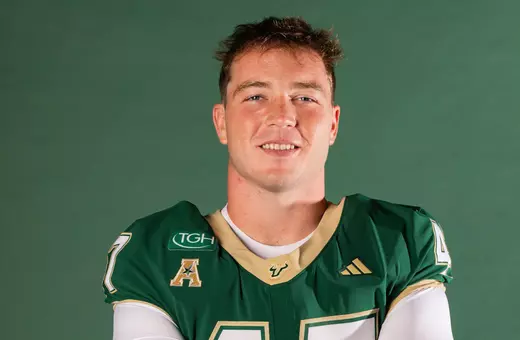
As USF's winter conditioning began, Turner singled out tight end Wyatt Sullivan as a player who "when he walks into the weight room, he's ready to train and ready to work. You feel their energy and their presence. It's contagious.''
Turner said energy and presence are essential in mat drills.
"They (mat drills) are a program-defining moment,'' Turner said. "You play 16 or 17 weeks of a football season and you don't know when those (key) moments will come. But they're going to come and adversity will strike. How you respond to those moments often dictates the outcome. You don't know how it's going to look, but ultimately, you've got to respond to it and win that moment.
"The ultimate lesson that's learned is when your best is needed, did you give your best? When your team needs you the most, did you give your best? That's the big-picture takeaway for the mat drills. The lights are going to be bright. People are watching. You're going to be scored. There will be a winner and a loser. No one cares about talent or any other stuff. It's early in the morning. You might be tired. Literally, no one cares. Just like a football game, it's about giving your best. And the ability to do that in all situations, that's what we want to see from our guys.''
In the ever-changing world of college football, Turner's time-honored principles remain the same. They're meant to develop USF football into not only a championship contender, but a championship winner.
"This place is hungry to win,'' Turner said. "That's what we're all about. That's our mindset and we're getting after it.
"We're hungry for not just American Conference championships, but Power Four conference championships and national championships. I mean, that's coming from (CEO of Athletics) Rob Higgins himself. If he's going to say it boldly and believe in it, we've all got to say it boldly and believe in it. That's the type of place we have. And these are the type of people that Coach Hartline has brought in — people who have seen it, done it, been around it and they know what it (winning) looks like. Those are the things we're going to stand for.''
–#GoBulls–
Joey Johnston
Athletics Senior Writer