30th Anniversary Series: Essential Program Moments
September 13, 2026 | Football

30th Anniversary Series
PART 3: Essential Milestone Moments
Editor's Note: To commemorate the University of South Florida's 30th football season, GoUSFBulls.com is presenting a 12-part series that covers the sights, sounds, milestones, biggest games, top performers and unforgettable personalities from the program's first three decades.
The installments will appear each Sunday that precedes a South Florida game week.
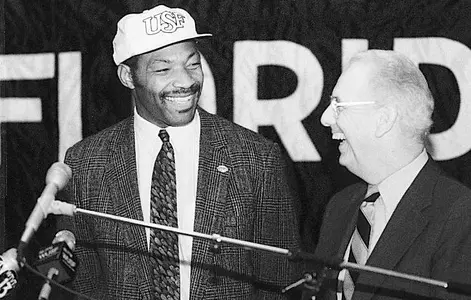
You can't write the history of University of South Florida football without including Lee Roy Selmon in the first chapter. He rallied the community behind the fledgling program and provided fundraising muscle. He was the face of the program — a respected and beloved source of inspiration and vision.
From 2001-04, he served as South Florida's athletic director. The school's main athletic facility is named in his honor. He began a mentoring program for South Florida student-athletes to prepare them for professional life.
Lee Roy Selmon was the first Tampa Bay Buccaneers' draft pick, a Pro Football Hall of Famer and arguably the franchise's greatest player.
Lee Roy Selmon, once owner of a popular barbecue restaurant chain, was a civic giant so large that his name adorns the Crosstown Expressway, a well-traveled thoroughfare the connects much of the area to downtown Tampa.
Lee Roy Selmon was also a symbol of South Florida football.
South Florida athletic director Paul Griffin lured Selmon away from a banking career in 1993, certainly one of the milestone moments in the program's development. Even the most skeptical sources knew that South Florida football was no longer just a concept. With Selmon's name recognition and credibility, it turned the corner toward reality.
"Potentially, we've hired the most effective builder of relationships that this university could ever have. I've never heard a bad word said about Lee Roy Selmon. I think the only people who don't like him are maybe a bunch of former offensive tackles and quarterbacks.''
Even now, 15 years after his shocking death at age 56 that rocked the South Florida community and the entire Tampa Bay Area, Selmon still influences the school's student-athletes, some of whom were in diapers when he passed.
"My father was a man of humility and very few words, but when he did speak, he spoke truth,'' said his son, former Bulls defensive lineman Lee Roy Selmon Jr. "He brought energy to the people around him. He loved this university. He bled green and gold.''
Lee Roy Selmon's story began in a place where the entire population could fit into USF's Selmon Athletics Center — the two-stoplight town of Eufaula, Okla., in America's heartland. He grew up on a farm, the youngest of nine children. The family had no indoor plumbing, refrigerator or air conditioner.
But no complaints, either.
"We had all we needed … and we were surrounded by love,'' Selmon once said.
At the University of Oklahoma, where Selmon teamed with brothers Lucious and Dewey on the defensive line, the Sooners were 43-2-1. As the inaugural draft pick for the expansion Buccaneers in 1976, Selmon had 78.5 sacks in nine NFL seasons before his career was cut short by a back injury. His football legend has endured.
"Lee Roy was Superman,'' former Bucs linebacker Richard Wood said.
"The way he got off the ball, that burst, it was pure attitude, something that came from within, a God-given gift,'' former Bucs tight end Jimmie Giles said.
Selmon was prepared for post-football life. He had been a banker in the offseason and easily transitioned to a financial career.
Even then, he was dreaming of a program to help student-athletes, who might encounter celebrity and money, but were sometimes ill-prepared for the responsibility of making it last after college and sports. Selmon's dream became a reality at South Florida with the Selmon Mentoring Institute and the offshoot Enhancing U program, which teaches leadership, social engagement and career development.
To the young people he still influences through his passion program, Lee Roy Selmon might be just a name lost in history. But what a name. And his initial hiring with South Florida football, then all the good it produced? What a milestone.
Other Essential Milestone Moments, which were key to the formation and progress of South Florida's football program:
 Hiring Paul Griffin (May 2, 1986) — When Griffin was hired from Jacksonville University as South Florida's athletic director, his initial charge was stabilizing the department and erasing its debt. But he quickly grasped the importance of adding football. Griffin said it could serve as a catalyst for the athletic department — and the school as a whole — for projected growth into the 21st century. "Football is not just a nice thing to have,'' Griffin said. "It's necessary.''
Feasibility Committee Meets (October 13, 1991) — South Florida president Frank Borkowski appointed a 40-person committee — comprised of faculty, staff, students, alumni and community friends — to assess the feasibility of adding a football program. The committee chairman is Leon Mandell, USF ombudsman, chemistry professor and former dean of the College of Natural Sciences.
Moving Forward (Jan. 30, 1992) — Mandell releases a report that states a football program is feasible at South Florida. After studying football's potential effects on academics, economics, other athletic programs and the reaction of the school's constituency, Mandell wrote that football should "meet the highest standards of academic and NCAA protocol.'' Borkowski plans to meet with other groups (student government, faculty senate and athletics council) for more feedback. "We will grow as fast as our loyal alumni and our Tampa area fans will support,'' Mandell wrote.
Community Support Galvanizes (Aug. 24, 1993) — With the stated fundraising goal of $10-million (and a $5-million endowment before seeking State Board of Regents approval for South Florida football), Tampa attorney and sports activist Ed Rood pledges a $2-million gift to the USF Football Fundraising Committee, co-chaired by Tampa businessman Frank Morsani and retired GTE South president Payton Adams.
 South Florida Football Is Approved (Sept. 15, 1995) — With South Florida football judged to be feasible and a $5-million endowment raised, Florida's State Board of Regents approves the program by a 13-1 vote during its meeting in Orlando.
Hiring Jim Leavitt (Dec. 3, 1995) — Leavitt, the co-defensive coordinator at Kansas State University and a St. Petersburg native, is named South Florida's first head football coach. Leavitt was among five finalists who were brought to campus for interviews.
New Stadium Approved (Sept. 3, 1996) — A $168-million publicly funded stadium, to be built on the site of the existing Tampa Stadium, wins approval of Tampa voters (passing with 53 percent). South Florida football will open at Tampa Stadium in 1997, then shift in 1998 to the new facility, which is named Raymond James Stadium.
First Public Scrimmage (Sept. 25, 1996) — South Florida football debuts with 28 practices and no games during 1996. But an on-campus public scrimmage, held at USF's soccer stadium (and one set of goal posts at the west end), draws 4,975 fans. After the 96-play scrimmage, in which 10 touchdowns were scored, USF players toss miniature green-and-gold footballs into the stands.
 The First Game (Sept. 6, 1997) — Before a sellout crowd of 49,212 at Tampa Stadium, the South Florida Bulls open with an 80-3 victory against Kentucky Wesleyan. The early arriving crowd is festive and the Bulls put on a great show.
Finding A Conference Home (Oct. 11, 1999) — South Florida football, already planning a transition to the Football Bowl Subdivision in 2000, is approved for membership in Conference USA during the league's expansion meetings in New York. But instead of joining C-USA in 2002, the original plan, USF must wait until 2003 because the university presidents want two full seasons of FBS play.
Beating An FBS Team (Oct. 28, 2000) — During its 2000 transition season, it was a time of growth and scheduling four FBS opponents. Facing Kentucky, Baylor and Southern Miss — all on the road — the Bulls go 0-3 and lose by a combined 96-29 margin. The Bulls break through with a 21-13 victory at Connecticut.
 Building An Athletics Center (June 1, 2004) — The USF Athletics Center — an $18.2-million, 104,000-square-foot facility — is open for business. And with that, a humble era becomes history, the time of football coaching offices in trailers and a cramped weight room. In 2012, it is renamed the Lee Roy Selmon Athletics Center to honor the late Tampa Bay and USF athletic icon.
Big-Time In The Big East (July 1, 2005) — South Florida officially becomes members of the Big East Conference, one of the six leagues that gets automatic BCS bowl bids for its champions. The appointment was actually made in 2003 — about two months after USF had played its first C-USA football game — when the Big East sought new members following the ACC departure of Boston College, Miami and Virginia Tech. South Florida will join Big East football in the 2005 season.
The First Bowl Game (Dec. 31, 2005) — After challenging for the Big East championship in its first season, South Florida's hopes are deflated by a two-game losing streak. But the Bulls, with a conference affiliation, are lined up for the program's first bowl bid. South Florida falls 14-0 against the ACC's N.C. State Wolfpack in the Meineke Car Care Bowl in Charlotte, N.C.
Postseason Victory (Dec. 23, 2006) — Following an 8-4 regular season, which included six wins in the last eight games (including a road win at No. 7-ranked West Virginia), South Florida goes to the PapaJohns.com Bowl in Birmingham, Ala., and defeats the East Carolina Pirates 24-7. For the first time in program history, Coach Jim Leavitt and his players raise a postgame trophy.
 Showcase Game (Sept. 28, 2007) — Two weeks after entering the national rankings for the first time, No. 18 South Florida defeats No. 5 West Virginia 21-13 in a Friday night standalone ESPN2 game before a delirious throng of 67,012 at Raymond James Stadium. The game sells out three days earlier.
We're No. 2! (Oct. 14, 2007) — After moving to 6-0 — amid a flurry of upsets around the nation — the 11th-year South Florida football program is voted No. 2 in the Associated Press poll. USF's unprecedented ascent becomes the No. 1 topic of conversation among ESPN's talking heads, sports talk radio hosts and newspaper columnists.
Winning At FSU (Sept. 26, 2009) — Led by freshman quarterback B.J. Daniels, the South Florida Bulls stun the No. 18-ranked Florida State Seminoles 17-7 at Tallahassee's Doak Campbell Stadium. It's the first South Florida victory against a member of the state's "Big Three'' and establishes the Bulls as a serious contender.
Winning At Notre Dame (Sept. 3, 2011) — The South Florida Bulls open the 2011 season with a 23-20 road upset of the No. 16-ranked Notre Dame Fighting Irish. The subplots were everywhere. Bulls coach Skip Holtz was a former player at Notre Dame, where his father, Lou, was head coach of a national-championship team in 1988.
Winning 11 Games (Dec. 29, 2016) — Capping the most successful season in program history, the South Florida Bulls defeat the SEC's South Carolina Gamecocks 46-39 in overtime at the Birmingham Bowl. The Bulls (11-2) finish 19th in the final Associated Press poll.
 Opening An Indoor Facility (Nov. 9, 2022) — The $22-million, 88,000-square-foot Porter Family Indoor Performance Facility gave South Florida's football program the ability to hold indoor practices away from the lightning and rain common to Tampa's summer climate, while providing occasional breaks from intense heat. The IPF features Savage Field, a 100-yard turf field, plus a JBL sound system, a branded lobby and an observation deck.
Hiring Alex Golesh (Dec. 4, 2022) — Following a 1-11 finish — the program's fourth straight losing season — South Florida hires Tennessee offensive coordinator Alex Golesh as the program's sixth head coach. Golesh produces a three-year record of 23-16, three straight winning seasons, three bowl appearances (two victories), two wins against nationally ranked opponents and a fast-paced offense that ranked No. 5 nationally in 2025 (averaging 40.5 points per game).
Ground-Breaking Moment (Nov. 8, 2024) — Ground is broken for South Florida's $348.5-million, 35,000-seat on-campus stadium, which is set to open in 2027. "Our new stadium will have a major impact on the University of South Florida's future, not only on the field, but in ways that extend well beyond athletics,'' school president Rhea Law said. "The stadium will greatly enhance the experience for our students and will provide a compelling reason for our alumni and future generations of Bulls fans to visit our campus.''
Winning At Florida (Sept. 6, 2025) — The South Florida Bulls head to Gainesville and upset the No. 13-ranked Florida Gators 18-16 at the Swamp, winning on Nico Gramatica's 20-yard walk-off field goal. South Florida becomes only the ninth program in history to win games at Florida, at FSU and at Miami — the state's "Big Three.''
 Hiring Rob Higgins (Sept. 9, 2025) — South Florida hires Rob Higgins, executive director of the Tampa Bay Sports Commission, as its CEO of Athletics. Higgins, a proud alumnus who began his association with South Florida athletics as a men's basketball ball-kid and manager, said the football program (and athletics in general) will pursue the highest levels of national excellence. "All gas, no brakes,'' he said, setting an urgent tone.
CFP Standings For First Time (Nov. 11, 2025) — The South Florida Bulls are No. 24 in the College Football Standings, the program's first appearance since the CFP began its weekly standings in 2014.
Hiring Brian Hartline (Dec. 3, 2025) — South Florida hires Ohio State offensive coordinator Brian Hartline as the program's seventh head coach. Hartline, considered one of the brightest young leaders in college football, said he saw no limitations with the Bulls' program and believed it could achieve the highest goals.
–#30thAnniversary–
Joey Johnston
Athletics Senior Writer