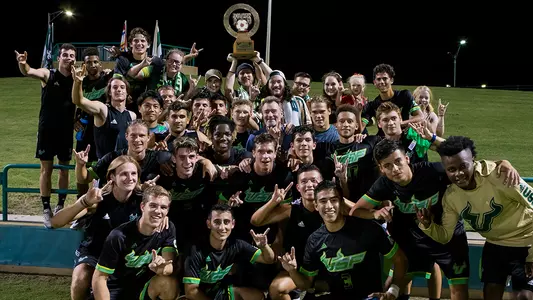
The USF-UT Rowdies Cup: A Tampa Tradition
August 13, 2021 | Men's Soccer
By Joey Johnston
TAMPA (Aug. 13, 2021) – When the USF Bulls open the men's soccer season Tuesday night against the University of Tampa Spartans, the exhibition event will be known as the Rowdies Cup. It will be preceded by a USF-UT alumni game and all the money goes to charity (this season's beneficiary is the Children's Cancer Center of Tampa).
Click here to donate to the Children's Cancer Center, or donate at Corbett Stadium on match night.
"Of course, we want to win and play well, but the biggest thing will be playing a lot of guys and looking at players,'' USF coach Bob Butehorn said. "UT is probably the same way. It's great to have USF and UT playing in soccer, but it's not quite what it used to be.''
At its apex, the men's soccer crosstown rivalry game between the Bulls and Spartans was a major highlight on Tampa's sports calendar. It was known as the Mayor's Cup. Butehorn, a former UT midfielder, experienced all the highlights.
Shortly before the 1983 contest and the formal dedication of UT's Pepin/Rood Stadium, Butehorn remembers looking in the sky to follow the spectacular descent of two paratroopers who delivered the game ball to the field. The hard sellout crowd of 5,707 fans (several hundred more people lined the fences, meaning more than 6,000 were on hand) roared its approval.
"I was shaking,'' Butehorn said. "It was an unbelievable scene. It was nerve-wracking and filled with tension. It was as big-time as you could get.''
One of the fans that night was young Adrian Bush, who couldn't get a ticket. So, he peered through a chain-link fence in the corner. Bush is now UT's head coach.
"If you were in Tampa back then and you liked soccer, you went to the Mayor's Cup,'' Bush said. "Most years, it was two monsters on different sides of the city coming together to decide the bragging rights. It was absolutely epic.
"It's a little different now because we're both looking at our players and gearing up for the season. But it's still serious. It still has meaning. It's still something you want to hang on to.''
What does the Rowdies Cup mean now?
"You don't want to sound like an old man when you're talking to your players about what it was like back in the day,'' Butehorn said. "I describe it like this: It's good competition. It has meaning in this city. The USF and UT alumni will play before us (at 5:30). It surely means a lot to them. Once you get on the field, you'll feel the intensity. We have to preserve it. I think we need to find a path to make it as big as it can be. Obviously, some of the circumstances have changed.''
These days, with the strength-of-schedule criteria needed for NCAA Tournament qualification, it's not in USF's best interests to schedule a Division II opponent such as UT. Bush understands that.
"It's kind of sad, but it's not their fault,'' Bush said. "It's just the way things are. They can't take that risk. I know people are always going to paint it as 'USF is scared to play UT,' but that's not really the case. There's respect between the programs. Both programs are high-quality.''
Jay Miller, UT's coach from 1977-86 before shifting to USF for the next seven seasons, was a key figure behind the Mayor's Cup. As Miller built the Spartans into respectability and beyond — UT won the 1981 NCAA Division II national championship — he stoked the fires by insisting on an annual crosstown rivalry game.
"It just made sense,'' Miller said. "The players wanted the competition. The fans loved it. Everybody knew it could become a great event in town.''
In 1980, the timing seemed perfect. Tampa was a soccer town. The Tampa Bay Rowdies were at the height of popularity in the North American Soccer League, attracting 56,389 fans for a 1980 Fourth of July game at the old Tampa Stadium, then 54,247 for a showdown against the hated New York Cosmos. Boys and girls high-school soccer had just arrived in the public schools after the Rowdies lobbied for approval by the Hillsborough County School Board.
The school presidents, UT's Richard Cheshire and USF's John Lott Brown, agreed that an annual high-stakes men's soccer match would be mutually beneficial. Tampa mayor Bob Martinez (the future Florida governor) stepped up and announced that the winner would receive a handsome trophy — the Mayor's Cup, donated by Pepin Distributors — to keep on campus for the year.
The match drew week-long front-page newspaper coverage from the morning Tampa Tribune and the afternoon Tampa Times, along with multiple live shots from local television stations.
"I think it opened the eyes of the public, which was used to the Rowdies, and now they could see some high-level college soccer in their town, too,'' Miller said.
UT was 11-1 and ranked fourth in Division II.
USF was 7-1-1 and ranked fifth in the South Region, while coming off a victory against Clemson. The first official Mayor's Cup was played on Halloween eve at USF. During player introductions, Bulls players wore masks, then tossed candy treats to the fans.
USF prevailed 3-1 before 3,200 fans. The Mayor's Cup was a 2-2 draw in 1981, when UT captured its first men's soccer national title.
In 1982, before 4,118 fans, UT won 1-0 on a controversial play. UT's Keith Fulk was taken down by USF's Lenny Armuth inside the box — a call vehemently protested by USF coach Dan Holcomb — and Hans Olofsson converted the penalty kick at 77:13.
The Spartans won it 2-0 in 1983, before the record paid crowd of 5,707 and huge standing-room bonus attendance. By 1984, when UT won 2-1 on Rick Sylvester's goal in the second overtime, the Spartans had clearly gained the psychological advantage.
Then the tide turned again.
From 1985-89, the Bulls defeated the Spartans five straight times, outscoring them 19-6. UT regained the upper hand, winning twice and tying once, then the Mayor's Cup went into the deep freeze. After 1992, it was relegated to an exhibition because USF, after shifting from the Sun Belt to the Metro Conference, instituted a policy of not scheduling regular-season games against Division II opponents.
"Yes, I was the USF coach when it stopped,'' said Miller, who now lives in suburban Atlanta, while working for Major League Soccer and the United State Soccer Federation. "I hated it, but USF as an administration just decided that the Mayor's Cup no longer worked for the athletic department. So that was that.
"I'd like to see it come back in the highest possible capacity. It definitely has value for both schools and the Tampa soccer community.''
Butehorn said he believes the Mayor's Cup/Rowdies Cup belongs in the spring, when USF and UT generally train against Major League Soccer and international teams. NCAA Division I is considering a proposal that would split the men's soccer season between the fall and spring, perhaps creating more validity for a springtime UT-USF match.
"I think it could come back in a really big way,'' Butehorn said. "Obviously, I have lived on both sides of it. I think it's great for soccer in Tampa. I know Adrian (Bush) feels the same way. Let's make it into a huge event again.''
About USF Men's Soccer
To stay up-to-date on the latest USF Men's Soccer news, follow the Bulls on social media (Twitter | Facebook | Instagram).
USF Men's Soccer competed in the school's first ever intercollegiate athletic contest on Sept. 25, 1965, beating Florida Southern 4-3. Since then, the oldest program on campus has built a winning tradition, claiming 14 conference championships and making 21 NCAA Tournament appearances, including 3 trips to the elite eight.
The program also has a strong reputation within the professional game and boasts 29 MLS draft picks. Notable alumni include two-time MLS Golden Boot winner Jeff Cunningham, USA 1994 World Cup star Roy Wegerle, and 2013 MLS Cup winner Dom Dwyer.
The Bulls have advanced to the postseason in 18 of the past 20 years, including 12 NCAA Tournament appearances during that period.
USF Soccer concluded the 2020 season with four players earning AAC honors, highlighted by first first-team selection Josue Monge and Salvatore Mazzaferro who was tabbed a second-team selection. Also, Oscar Resano and Brian Schaefer were named to the American Athletic Conference All-Rookie Team. Head coach Bob Butehorn returns to lead USF in his fifth season on the sidelines.
– #GoBulls –
TAMPA (Aug. 13, 2021) – When the USF Bulls open the men's soccer season Tuesday night against the University of Tampa Spartans, the exhibition event will be known as the Rowdies Cup. It will be preceded by a USF-UT alumni game and all the money goes to charity (this season's beneficiary is the Children's Cancer Center of Tampa).
Click here to donate to the Children's Cancer Center, or donate at Corbett Stadium on match night.
"Of course, we want to win and play well, but the biggest thing will be playing a lot of guys and looking at players,'' USF coach Bob Butehorn said. "UT is probably the same way. It's great to have USF and UT playing in soccer, but it's not quite what it used to be.''
At its apex, the men's soccer crosstown rivalry game between the Bulls and Spartans was a major highlight on Tampa's sports calendar. It was known as the Mayor's Cup. Butehorn, a former UT midfielder, experienced all the highlights.
Shortly before the 1983 contest and the formal dedication of UT's Pepin/Rood Stadium, Butehorn remembers looking in the sky to follow the spectacular descent of two paratroopers who delivered the game ball to the field. The hard sellout crowd of 5,707 fans (several hundred more people lined the fences, meaning more than 6,000 were on hand) roared its approval.
"I was shaking,'' Butehorn said. "It was an unbelievable scene. It was nerve-wracking and filled with tension. It was as big-time as you could get.''
One of the fans that night was young Adrian Bush, who couldn't get a ticket. So, he peered through a chain-link fence in the corner. Bush is now UT's head coach.
"If you were in Tampa back then and you liked soccer, you went to the Mayor's Cup,'' Bush said. "Most years, it was two monsters on different sides of the city coming together to decide the bragging rights. It was absolutely epic.
"It's a little different now because we're both looking at our players and gearing up for the season. But it's still serious. It still has meaning. It's still something you want to hang on to.''
What does the Rowdies Cup mean now?
"You don't want to sound like an old man when you're talking to your players about what it was like back in the day,'' Butehorn said. "I describe it like this: It's good competition. It has meaning in this city. The USF and UT alumni will play before us (at 5:30). It surely means a lot to them. Once you get on the field, you'll feel the intensity. We have to preserve it. I think we need to find a path to make it as big as it can be. Obviously, some of the circumstances have changed.''
These days, with the strength-of-schedule criteria needed for NCAA Tournament qualification, it's not in USF's best interests to schedule a Division II opponent such as UT. Bush understands that.
"It's kind of sad, but it's not their fault,'' Bush said. "It's just the way things are. They can't take that risk. I know people are always going to paint it as 'USF is scared to play UT,' but that's not really the case. There's respect between the programs. Both programs are high-quality.''
Jay Miller, UT's coach from 1977-86 before shifting to USF for the next seven seasons, was a key figure behind the Mayor's Cup. As Miller built the Spartans into respectability and beyond — UT won the 1981 NCAA Division II national championship — he stoked the fires by insisting on an annual crosstown rivalry game.
"It just made sense,'' Miller said. "The players wanted the competition. The fans loved it. Everybody knew it could become a great event in town.''
In 1980, the timing seemed perfect. Tampa was a soccer town. The Tampa Bay Rowdies were at the height of popularity in the North American Soccer League, attracting 56,389 fans for a 1980 Fourth of July game at the old Tampa Stadium, then 54,247 for a showdown against the hated New York Cosmos. Boys and girls high-school soccer had just arrived in the public schools after the Rowdies lobbied for approval by the Hillsborough County School Board.
The school presidents, UT's Richard Cheshire and USF's John Lott Brown, agreed that an annual high-stakes men's soccer match would be mutually beneficial. Tampa mayor Bob Martinez (the future Florida governor) stepped up and announced that the winner would receive a handsome trophy — the Mayor's Cup, donated by Pepin Distributors — to keep on campus for the year.
The match drew week-long front-page newspaper coverage from the morning Tampa Tribune and the afternoon Tampa Times, along with multiple live shots from local television stations.
"I think it opened the eyes of the public, which was used to the Rowdies, and now they could see some high-level college soccer in their town, too,'' Miller said.
UT was 11-1 and ranked fourth in Division II.
USF was 7-1-1 and ranked fifth in the South Region, while coming off a victory against Clemson. The first official Mayor's Cup was played on Halloween eve at USF. During player introductions, Bulls players wore masks, then tossed candy treats to the fans.
USF prevailed 3-1 before 3,200 fans. The Mayor's Cup was a 2-2 draw in 1981, when UT captured its first men's soccer national title.
In 1982, before 4,118 fans, UT won 1-0 on a controversial play. UT's Keith Fulk was taken down by USF's Lenny Armuth inside the box — a call vehemently protested by USF coach Dan Holcomb — and Hans Olofsson converted the penalty kick at 77:13.
The Spartans won it 2-0 in 1983, before the record paid crowd of 5,707 and huge standing-room bonus attendance. By 1984, when UT won 2-1 on Rick Sylvester's goal in the second overtime, the Spartans had clearly gained the psychological advantage.
Then the tide turned again.
From 1985-89, the Bulls defeated the Spartans five straight times, outscoring them 19-6. UT regained the upper hand, winning twice and tying once, then the Mayor's Cup went into the deep freeze. After 1992, it was relegated to an exhibition because USF, after shifting from the Sun Belt to the Metro Conference, instituted a policy of not scheduling regular-season games against Division II opponents.
"Yes, I was the USF coach when it stopped,'' said Miller, who now lives in suburban Atlanta, while working for Major League Soccer and the United State Soccer Federation. "I hated it, but USF as an administration just decided that the Mayor's Cup no longer worked for the athletic department. So that was that.
"I'd like to see it come back in the highest possible capacity. It definitely has value for both schools and the Tampa soccer community.''
Butehorn said he believes the Mayor's Cup/Rowdies Cup belongs in the spring, when USF and UT generally train against Major League Soccer and international teams. NCAA Division I is considering a proposal that would split the men's soccer season between the fall and spring, perhaps creating more validity for a springtime UT-USF match.
"I think it could come back in a really big way,'' Butehorn said. "Obviously, I have lived on both sides of it. I think it's great for soccer in Tampa. I know Adrian (Bush) feels the same way. Let's make it into a huge event again.''
About USF Men's Soccer
To stay up-to-date on the latest USF Men's Soccer news, follow the Bulls on social media (Twitter | Facebook | Instagram).
USF Men's Soccer competed in the school's first ever intercollegiate athletic contest on Sept. 25, 1965, beating Florida Southern 4-3. Since then, the oldest program on campus has built a winning tradition, claiming 14 conference championships and making 21 NCAA Tournament appearances, including 3 trips to the elite eight.
The program also has a strong reputation within the professional game and boasts 29 MLS draft picks. Notable alumni include two-time MLS Golden Boot winner Jeff Cunningham, USA 1994 World Cup star Roy Wegerle, and 2013 MLS Cup winner Dom Dwyer.
The Bulls have advanced to the postseason in 18 of the past 20 years, including 12 NCAA Tournament appearances during that period.
USF Soccer concluded the 2020 season with four players earning AAC honors, highlighted by first first-team selection Josue Monge and Salvatore Mazzaferro who was tabbed a second-team selection. Also, Oscar Resano and Brian Schaefer were named to the American Athletic Conference All-Rookie Team. Head coach Bob Butehorn returns to lead USF in his fifth season on the sidelines.
– #GoBulls –

Players Mentioned
D
/ Men's Soccer
MF
/ Men's Soccer
F
/ Men's Soccer
MF
/ Men's SoccerFriday, October 17
Saturday, December 07
Wednesday, November 13
Saturday, October 26



