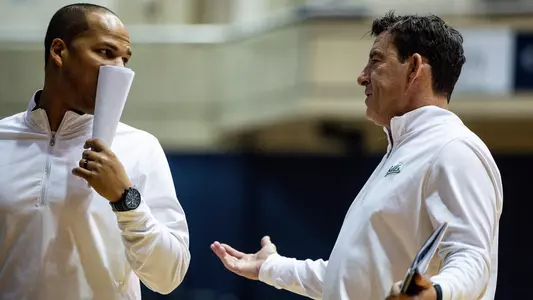
Photo by: Mary Holt / University of South Florida Athletics
The Commander, Mark McGinnis
March 11, 2024 | Men's Basketball
Joey Johnston/Athletics Senior Writer
TAMPA, Fla. (March 11, 2024) – In early January, a new face emerged at USF men's basketball practice, a place where you never see strangers. He paced around the Yuengling Center sidelines, studying the drills, occasionally writing notes in his small pad. When he stood, it was upright, at attention, his eyes laser-focused on the details.
A few players figured it was a visiting coach. Others thought it was a donor who wanted an inside look at the team. During water breaks, he huddled in the corner with Coach Amir Abdur-Rahim. They spoke quietly. Afterward, he wrote more notes.
"I remember seeing him and asking one of our coaches, 'Who is that guy?' '' Bulls guard Kasen Jennings said. "He said, 'That's the Commander.' And I was like, 'The Commander?' ''
Mark McGinnis, a former Navy SEAL of 24 years who serves as a motivational speaker and leadership consultant, introduced himself to the USF players and outlined his background.
"I know what it means to lead under pressure,'' McGinnis said in his introductory remarks to a roomful of incredulous and wide-eyed USF Bulls. "I know how to thrive in an environment that's hostile and challenging and rapidly changing. I know how to be competitive and win at a high level and what kind of hard work is necessary to get that done.
"And now, I'm here to help you.''
When Abdur-Rahim was an assistant on Billy Kennedy's Texas A&M staff, he met McGinnis, who draws upon his Navy SEAL background to work with teams in college basketball and college football, along with the NBA and NFL.
Abdur-Rahim asked McGinnis to observe his team and staff, while mentoring and providing a sounding board for Bulls players. McGinnis came aboard at the start of the American Athletic Conference schedule, a historic run that has produced the program's first national ranking, a 23-6 record, a 15-game winning streak (which ended with Saturday's 76-70 defeat at Tulsa) and a No. 1 seed in this week's AAC Tournament at Dickies Arena in Fort Worth, Texas.
I t's easy to suggest that McGinnis had a profound influence on USF's on-court success in Abdur-Rahim's first season.
"No, no, no,'' McGinnis said, quickly deflecting the premise. "I don't have any part in wins and losses. Regardless of a game's outcome, my goal is helping them to be better people. If that quality helps them win more games, so be it.
"I think the biggest responsibility that a collegiate coach has is to take young boys and girls and turn them into young men and women who are morally upright solid citizens that leave to become great ambassadors of that university and positive contributors to society. If good people are living the right way, good things are going to happen.''
Since arriving at USF, Abdur-Rahim has emphasized connection and culture. He said he's judged on winning games, but his preferred job description is developing young men.
"Having Commander McGinnis around has been great for our team and he has just been a phenomenal friend to me,'' Abdur-Rahim said. "You go to another level when you become a player-driven team. The more our players can learn about leadership, the better our team will be. He's a careful observer. He's a listener. And he makes you think.''
A Different World
"Who can tell me what it's like to play hard?''
At first, the USF players stared at McGinnis before looking around in confusion. Then they began speaking up, one by one.
"Emptying the tank.''
"Going 100 percent all the time.''
"Never giving in to fatigue.''
McGinnis nodded.
"OK, very good, very good,'' he said. "I like it. Those are all good answers. You know the funny thing? When you've emptied that tank, when you think you're going as hard as possible, you're actually using only about 60 percent of your capacity. You've got 40 percent more than you don't even know is there. The key is having the ability to flip the switch and utilize that.
"Now who can tell me what it's like to be a good teammate?''
The USF players were fully engaged.
"Being unselfish. Being accountable.''
"Doing whatever the coach asks.''
"When you care about helping the team win, not just your individual stats.''
McGinnis nodded again.
"All of that is great and all of that is definitely what you're looking for on any team,'' McGinnis said.
"But let me give you a glimpse into my world. Let me tell you what it's like to play hard and be a good teammate in my world.''
McGinnis told stories of SEAL missions, including one where a team closed in on an insurgent group. The first two teammates entered the room, essentially walking into an ambush, but they refused to demand help, choosing to protect the safety of the others while courageously turning back the enemy, against all odds.
As a room of quiet players stared back at McGinnis, his points of honor and loyalty were clearly illustrated.
This was a different level of playing hard.
This was a different level of being a good teammate.
Not A Video Game
Most of the USF players are into video games. They have mindlessly shot down the imaginary enemy while playing "Call of Duty'' or "Black Ops.''
It will never be the same.
"The Commander taught us that adversity is always looking for us and real life isn't like a video game,'' Bulls forward Kasean Pryor said. "Nobody is giving anything to the USF Bulls. Around every corner, there's someone looking to take you down and snack you in the face. So you've got to be committed and realize we're all on this line together. We've got to trust each other.''
"What we do for USF basketball doesn't remotely compare to what the Commander has done for us and this country,'' guard Jose Placer said. "Having him here has been a true blessing. After being around him, how could you not give it your all every day?''
"All season long, the Commander has put certain gems in our head,'' Jennings said. "I sit next to him on the bench. He's a brilliant man. He sees the game in a different way.''
McGinnis said he's trained in "asymmetrical thinking.'' He finds solutions when others believe a situation is impossible and outside their capabilities. He's also another set of eyes to observe USF's practices and games.
"I deal in habits, communication styles, culture and leadership,'' McGinnis said. "We talk about the artificial harmony you see in some team situations. We can't stand artificial harmony. I'd rather have open conflict. At least we're being honest and we can deal with it. With artificial harmony, we're never going to grow and we're never going to deal with issues.
"Sometimes, a coach just wants a safe harbor, somebody they can talk to and bounce ideas off. Just a neutral party who gives unbiased and unfiltered opinions. That's what I do.''
McGinnis said he looks for backsliding. Maybe a coach gets stuck in a rut. Does a team live up to its standard and identity? If a coach compromises in those areas, how can the players grow?
McGinnis said he marvels at Abdur-Rahim's coaching style and his leadership growth since the days as Texas A&M assistant.
"Amir is extremely direct,'' McGinnis said. "He's not afraid of conflict. He coaches hard and expects players to meet the standard he has established. But unlike some of the hard-coaching people I've seen, he does it from the perspective of love and caring about the person's development first. He genuinely cares about these kids.''
Little things are paramount in Abdur-Rahim's approach. It's the same for McGinnis. If he isn't watching body language and whether a player follows instructions to always keep his jersey tucked in, he's observing how the Bulls line up in a huddle.
Or maybe he's teaching a manager to quickly grab the coaching board during a timeout and circle where the ball is located on the floor. That way, Abdur-Rahim doesn't waste precious seconds on the basics.
"The little inefficiencies drive you crazy and could be the difference between winning and losing,'' McGinnis said. "When I was getting shot or getting my ass kicked, I wish I could've called a timeout. You know, take a knee, drink some water, call a different play. How valuable would that have been?
"In college basketball, the talent levels are often the same. The programs can look pretty similar. The teams who figure out the little things are the ones who usually win. People ask if the little things really make a difference. It boils down to this: What you do in the dark is always going to show up in the light.''
McGinnis spends much of his time working with corporations. But as a former football player at the U.S. Naval Academy, sports remain near and dear to his heart.
He loves a good success story. And while he won't take credit for the dramatically different won-loss record, McGinnis has grown fond of the USF Bulls and the strides they have made, both as a team and with individual players.
"What I always tell people is I'll shoot you straight,'' McGinnis said. "If you don't want to know the truth, then don't ask me the question. The world I'm in now is about these coaches and these players. I want to see them realize their goals and dreams. That's why I'm here. When I see that happening, it gives me such a great joy.''
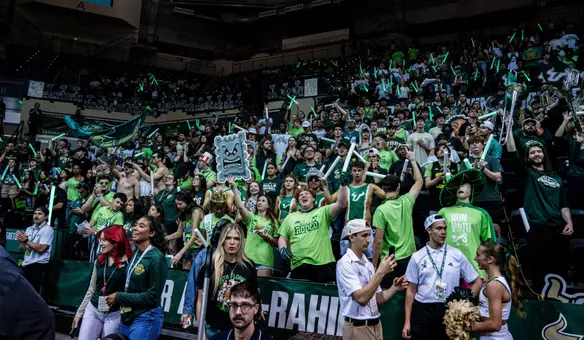
The Bulls are marching to Fort Worth on the strength of a dedicated coaching staff, a battle-tested roster, a rabid fan base … and one very proud Commander.
To stay up-to-date on the latest USF men's basketball news, follow the Bulls on social media (Twitter | Facebook | Instagram).
About USF Men's Basketball
The South Florida men's basketball team is led by Amir Abdur-Rahim, who was named the 11th head coach in program history on March 29, 2023. Abdur-Rahim was named the 2023 Mid-Major Coach of the Year (Hugh Durham Award) after leading Kennesaw State to its first-ever Division I NCAA Tournament berth in 2022-23. Abdur-Rahim's Kennesaw State team set an NCAA record as the fastest team to ever reach the NCAA Tournament after a one-win campaign, accomplishing the feat in a span of just three seasons. He was also named the 2022-23 NABC District 3 and ASUN Coach of the Year after leading Kennesaw State to both the regular season and tournament titles, and a school-record 26 wins.
USF has retired three numbers in its history: Chucky Atkins (12), Charlie Bradley (30), and Radenko Dobras (31). The Bulls have earned three NCAA tournament bids, appeared in the NIT eight times, and won the 2019 College Basketball Invitational.
For tickets, contact the USF Ticket Office at 1-800-Go-Bulls or by going online to USFBullsTix.com. Season tickets for the 2023-24 USF men's basketball slate are on sale now. To purchase season tickets, click here.
– #GoBulls –
A few players figured it was a visiting coach. Others thought it was a donor who wanted an inside look at the team. During water breaks, he huddled in the corner with Coach Amir Abdur-Rahim. They spoke quietly. Afterward, he wrote more notes.
"I remember seeing him and asking one of our coaches, 'Who is that guy?' '' Bulls guard Kasen Jennings said. "He said, 'That's the Commander.' And I was like, 'The Commander?' ''
Mark McGinnis, a former Navy SEAL of 24 years who serves as a motivational speaker and leadership consultant, introduced himself to the USF players and outlined his background.
"I know what it means to lead under pressure,'' McGinnis said in his introductory remarks to a roomful of incredulous and wide-eyed USF Bulls. "I know how to thrive in an environment that's hostile and challenging and rapidly changing. I know how to be competitive and win at a high level and what kind of hard work is necessary to get that done.
"And now, I'm here to help you.''
When Abdur-Rahim was an assistant on Billy Kennedy's Texas A&M staff, he met McGinnis, who draws upon his Navy SEAL background to work with teams in college basketball and college football, along with the NBA and NFL.
Abdur-Rahim asked McGinnis to observe his team and staff, while mentoring and providing a sounding board for Bulls players. McGinnis came aboard at the start of the American Athletic Conference schedule, a historic run that has produced the program's first national ranking, a 23-6 record, a 15-game winning streak (which ended with Saturday's 76-70 defeat at Tulsa) and a No. 1 seed in this week's AAC Tournament at Dickies Arena in Fort Worth, Texas.
I
t's easy to suggest that McGinnis had a profound influence on USF's on-court success in Abdur-Rahim's first season."No, no, no,'' McGinnis said, quickly deflecting the premise. "I don't have any part in wins and losses. Regardless of a game's outcome, my goal is helping them to be better people. If that quality helps them win more games, so be it.
"I think the biggest responsibility that a collegiate coach has is to take young boys and girls and turn them into young men and women who are morally upright solid citizens that leave to become great ambassadors of that university and positive contributors to society. If good people are living the right way, good things are going to happen.''
Since arriving at USF, Abdur-Rahim has emphasized connection and culture. He said he's judged on winning games, but his preferred job description is developing young men.
"Having Commander McGinnis around has been great for our team and he has just been a phenomenal friend to me,'' Abdur-Rahim said. "You go to another level when you become a player-driven team. The more our players can learn about leadership, the better our team will be. He's a careful observer. He's a listener. And he makes you think.''
A Different World
"Who can tell me what it's like to play hard?''
At first, the USF players stared at McGinnis before looking around in confusion. Then they began speaking up, one by one.
"Emptying the tank.''
"Going 100 percent all the time.''
"Never giving in to fatigue.''
McGinnis nodded.
"OK, very good, very good,'' he said. "I like it. Those are all good answers. You know the funny thing? When you've emptied that tank, when you think you're going as hard as possible, you're actually using only about 60 percent of your capacity. You've got 40 percent more than you don't even know is there. The key is having the ability to flip the switch and utilize that.
"Now who can tell me what it's like to be a good teammate?''
The USF players were fully engaged.
"Being unselfish. Being accountable.''
"Doing whatever the coach asks.''
"When you care about helping the team win, not just your individual stats.''
McGinnis nodded again.
"All of that is great and all of that is definitely what you're looking for on any team,'' McGinnis said.
"But let me give you a glimpse into my world. Let me tell you what it's like to play hard and be a good teammate in my world.''
McGinnis told stories of SEAL missions, including one where a team closed in on an insurgent group. The first two teammates entered the room, essentially walking into an ambush, but they refused to demand help, choosing to protect the safety of the others while courageously turning back the enemy, against all odds.
As a room of quiet players stared back at McGinnis, his points of honor and loyalty were clearly illustrated.
This was a different level of playing hard.
This was a different level of being a good teammate.
Not A Video Game
Most of the USF players are into video games. They have mindlessly shot down the imaginary enemy while playing "Call of Duty'' or "Black Ops.''
It will never be the same.
"The Commander taught us that adversity is always looking for us and real life isn't like a video game,'' Bulls forward Kasean Pryor said. "Nobody is giving anything to the USF Bulls. Around every corner, there's someone looking to take you down and snack you in the face. So you've got to be committed and realize we're all on this line together. We've got to trust each other.''
"What we do for USF basketball doesn't remotely compare to what the Commander has done for us and this country,'' guard Jose Placer said. "Having him here has been a true blessing. After being around him, how could you not give it your all every day?''
"All season long, the Commander has put certain gems in our head,'' Jennings said. "I sit next to him on the bench. He's a brilliant man. He sees the game in a different way.''
McGinnis said he's trained in "asymmetrical thinking.'' He finds solutions when others believe a situation is impossible and outside their capabilities. He's also another set of eyes to observe USF's practices and games.
"I deal in habits, communication styles, culture and leadership,'' McGinnis said. "We talk about the artificial harmony you see in some team situations. We can't stand artificial harmony. I'd rather have open conflict. At least we're being honest and we can deal with it. With artificial harmony, we're never going to grow and we're never going to deal with issues.
"Sometimes, a coach just wants a safe harbor, somebody they can talk to and bounce ideas off. Just a neutral party who gives unbiased and unfiltered opinions. That's what I do.''
McGinnis said he looks for backsliding. Maybe a coach gets stuck in a rut. Does a team live up to its standard and identity? If a coach compromises in those areas, how can the players grow?
McGinnis said he marvels at Abdur-Rahim's coaching style and his leadership growth since the days as Texas A&M assistant.
"Amir is extremely direct,'' McGinnis said. "He's not afraid of conflict. He coaches hard and expects players to meet the standard he has established. But unlike some of the hard-coaching people I've seen, he does it from the perspective of love and caring about the person's development first. He genuinely cares about these kids.''
Little things are paramount in Abdur-Rahim's approach. It's the same for McGinnis. If he isn't watching body language and whether a player follows instructions to always keep his jersey tucked in, he's observing how the Bulls line up in a huddle.
Or maybe he's teaching a manager to quickly grab the coaching board during a timeout and circle where the ball is located on the floor. That way, Abdur-Rahim doesn't waste precious seconds on the basics.
"The little inefficiencies drive you crazy and could be the difference between winning and losing,'' McGinnis said. "When I was getting shot or getting my ass kicked, I wish I could've called a timeout. You know, take a knee, drink some water, call a different play. How valuable would that have been?
"In college basketball, the talent levels are often the same. The programs can look pretty similar. The teams who figure out the little things are the ones who usually win. People ask if the little things really make a difference. It boils down to this: What you do in the dark is always going to show up in the light.''
McGinnis spends much of his time working with corporations. But as a former football player at the U.S. Naval Academy, sports remain near and dear to his heart.
He loves a good success story. And while he won't take credit for the dramatically different won-loss record, McGinnis has grown fond of the USF Bulls and the strides they have made, both as a team and with individual players.
"What I always tell people is I'll shoot you straight,'' McGinnis said. "If you don't want to know the truth, then don't ask me the question. The world I'm in now is about these coaches and these players. I want to see them realize their goals and dreams. That's why I'm here. When I see that happening, it gives me such a great joy.''
The Bulls are marching to Fort Worth on the strength of a dedicated coaching staff, a battle-tested roster, a rabid fan base … and one very proud Commander.
To stay up-to-date on the latest USF men's basketball news, follow the Bulls on social media (Twitter | Facebook | Instagram).
About USF Men's Basketball
The South Florida men's basketball team is led by Amir Abdur-Rahim, who was named the 11th head coach in program history on March 29, 2023. Abdur-Rahim was named the 2023 Mid-Major Coach of the Year (Hugh Durham Award) after leading Kennesaw State to its first-ever Division I NCAA Tournament berth in 2022-23. Abdur-Rahim's Kennesaw State team set an NCAA record as the fastest team to ever reach the NCAA Tournament after a one-win campaign, accomplishing the feat in a span of just three seasons. He was also named the 2022-23 NABC District 3 and ASUN Coach of the Year after leading Kennesaw State to both the regular season and tournament titles, and a school-record 26 wins.
USF has retired three numbers in its history: Chucky Atkins (12), Charlie Bradley (30), and Radenko Dobras (31). The Bulls have earned three NCAA tournament bids, appeared in the NIT eight times, and won the 2019 College Basketball Invitational.
For tickets, contact the USF Ticket Office at 1-800-Go-Bulls or by going online to USFBullsTix.com. Season tickets for the 2023-24 USF men's basketball slate are on sale now. To purchase season tickets, click here.
– #GoBulls –
Joey Johnston
Athletics Senior Writer
Players Mentioned


Monday, April 20
Tuesday, April 07
Tuesday, March 31
Tuesday, March 31



